
Last Updated on 24 June 2026
For years, search engine marketing has been a cornerstone of digital fundraising and brand building. We know how to bid on keywords, we understand user intent, and we’re comfortable optimising landing pages. But the way people discover information is changing. With OpenAI opening up its self‑serve ChatGPT Ads Manager, conversational AI is shifting from a research tool into a direct performance marketing channel.
OpenAI has been widening its self‑serve ads pilot across the US, Canada, Australia and New Zealand, with a UK rollout expected before long.
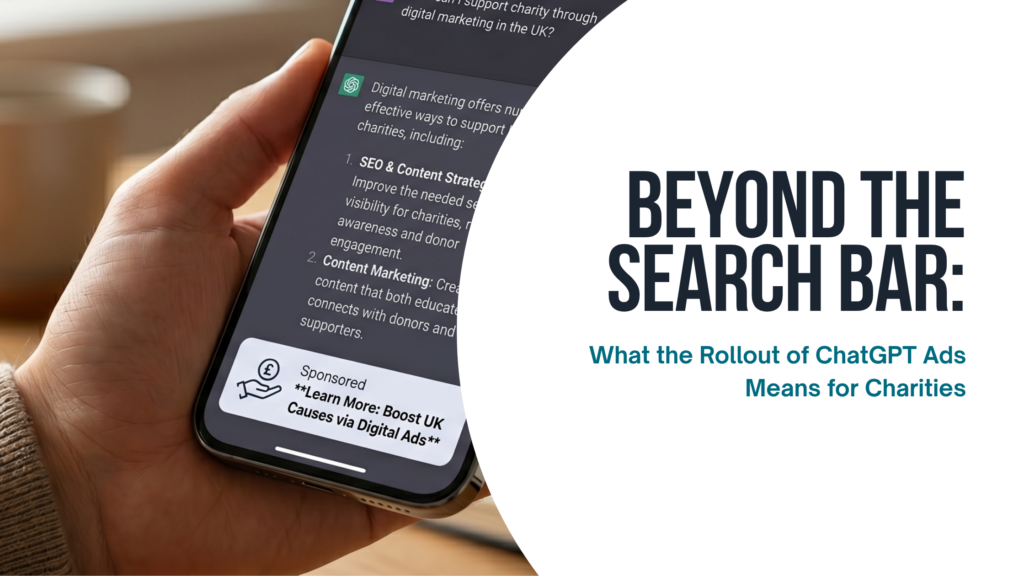
For charities, where every pound of media spend has to work hard, this could quietly become as important as Google Ads or Meta for reaching new supporters. Early data suggests that roughly one in five queries on ChatGPT’s free mobile app and its lower‑cost “Go” tier now trigger a sponsored ad. These placements don’t interrupt the response itself; they appear as clearly marked, clickable website links at the bottom of the answer. When this arrives in the UK, it will open up a new environment where you can reach donors and supporters in the exact moment they’re asking questions.
What we know so far
- Placement strategy
Ads are currently limited to the Free and Plus/Go tiers. Enterprise and business accounts remain ad‑free, so the audiences you’ll reach here are mainly everyday users rather than corporate teams. - Intent‑driven targeting
Targeting goes beyond simple keywords. Ads are matched to conversational topics, recent activity and stored memory, so placements are aligned to the context of the user’s question rather than a standalone search term. - The competitor landscape
If a user asks ChatGPT to compare organisations working on a particular cause, a competing charity could, in theory, bid to have its ad appear directly beneath that comparison. In traditional Google Ads campaigns, there’s often an unwritten rule not to bid on competitor brand terms, partly to avoid driving up CPCs for everyone. It’s not yet clear whether the charity sector will adopt similar etiquette on this new platform, or whether it will be more of a free‑for‑all.
Three core opportunities for charities
The move from high‑budget, invite‑only pilots to a self‑serve platform with cost‑per‑click (CPC) bidding means charities should be able to test ChatGPT ads without needing huge media budgets. Three areas look particularly promising:
- High‑intent donor acquisition
When someone asks a specific, action‑oriented question – such as “how to support local poverty charities” – sponsored call‑to‑action copy can appear directly beneath the AI’s response, pointing straight to your donation or “get involved” pages. For example, if someone asks, “What’s the best way to support cancer research in the UK?”, your ad could appear beneath the answer with a direct link to your monthly giving page. - Challenge and community events
Supporters are already using AI tools to research local activities, asking queries like “charity running events near me”. If your website and event registration pages are well optimised for AI (and traditional SEO), links to your event sign‑up pages can appear alongside ChatGPT’s suggested options. - Legacy giving and estate planning
Potential legacy supporters often do extra due diligence on the charities they plan to include in their Will. Being visible at the precise moment they ask an AI assistant about leaving a gift in their Will offers a very targeted way to surface legacy messaging and drive them towards more detailed information or a conversation with your team.
Getting ready for ChatGPT Ads in the UK
The platform is moving quickly from invitation‑only trials to more accessible self‑serve dashboards. Charities that want to be ready can start with a few practical steps:
- Audit your current AI visibility
As a starting point, pick five real supporter questions from your inbox and test how AI tools answer them today – that alone will give you a sense of where you are (and aren’t) visible. - Optimise for conversational queries
Plan content around the kinds of long‑form, question‑based queries people naturally ask an AI. This means doubling down on clear information architecture, schema/structured data and technically sound SEO so that answer engines can easily pull and synthesise your content. - Treat it as an experimental channel
As with any new ad platform, it’s sensible to ring‑fence a small test budget rather than pulling spend away from proven search or social activity. Use the early rollout (when it lands) to understand benchmarks, user behaviour and how conversational intent translates into donations, sign‑ups or leads.
Alongside performance, keep an eye on tone and safeguarding – ensure copy is accurate, empathetic and appropriate for people who may be searching at a vulnerable moment.
If you’d like to explore what an AI visibility audit could look like for your charity, or you want to get your digital framework in shape ahead of the UK rollout, do get in touch and we can arrange a chat.
Sources
- https://news.designrush.com/chatgpt-ads-google-search-budgets-implications
- https://www.jumpfly.com/blog/chatgpt-ads-are-here-why-brands-should-move-early-on-ai-advertising/
- https://www.youtube.com/watch?v=Erkjz_M5lCA
- https://www.getsmartacre.com/chatgpt-ads-101/
- https://openai.com/index/our-approach-to-advertising-and-expanding-access/
- https://www.trimarkdigital.com/blog/chatgpt-ads-future-of-search/
- https://www.monks.com/articles/answer-engine-battles-navigating-chatgpt-ad-rollout
- https://www.workshopdigital.com/blog/what-to-know-about-chatgpt-ads/